Reading Time: Approximately 18–20 Minutes
If you are reading this guide, you may have recently experienced the loss of someone close to you, or you may be planning ahead for yourself or a family member. Either situation often comes with questions, unfamiliar terminology, and important decisions that need to be made in a relatively short period of time.
One of the most common questions people ask is:
“What exactly is direct cremation?”
The answer is simpler than many people expect. Direct cremation is a respectful, dignified, and affordable option that allows cremation to take place without a public visitation or funeral service beforehand. Instead of organizing every aspect of a traditional funeral within a few days, families can focus on the immediate arrangements and decide later whether they would like to hold a celebration of life, memorial service, religious ceremony, or private gathering.
Over the past several decades, direct cremation has become an increasingly popular choice throughout Ontario. Families appreciate its simplicity, flexibility, and transparency, while still receiving the professional care and guidance of licensed Funeral Directors.
This guide explains everything you need to know about direct cremation in Ontario—from how the process works and what is included to common misconceptions, legal considerations, and frequently asked questions.
Our goal is to provide clear, practical information so you can make informed decisions with confidence.
Quick Answer
Direct cremation is the simplest form of cremation available in Ontario.
After a death occurs, a licensed funeral establishment transfers the deceased into its care, completes the required legal documentation, obtains the necessary authorizations, arranges the cremation, and returns the cremated remains to the family.
Unlike a traditional funeral, there is no public visitation or funeral service before the cremation.
If the family wishes, a memorial service, celebration of life, church service, or private gathering can still be held afterward.
For many Ontario families, direct cremation offers a dignified alternative that provides flexibility while avoiding many of the costs associated with a traditional funeral.
What Is Direct Cremation?
Direct cremation is a funeral arrangement in which the deceased is respectfully cared for by a licensed funeral establishment and cremated without a public visitation or formal funeral service beforehand.
The focus is on providing the essential professional services required after a death while giving families the flexibility to decide later how they wish to remember and celebrate the life of their loved one.
For many families, this approach removes the pressure of organizing a large gathering within only a few days. Instead, they can take additional time to notify relatives, arrange travel, choose an appropriate location, and plan a more personal memorial when everyone is able to participate.
Direct cremation is not a lesser form of care.
The same commitment to dignity, identification procedures, documentation, and professional standards applies regardless of whether a family chooses a traditional funeral or a direct cremation.
Every individual entrusted to a licensed funeral establishment deserves respectful treatment from the moment they enter professional care until the cremated remains are returned to the family.
Funeral Director’s Tip
“Many families believe that choosing direct cremation means giving up the opportunity to honour a loved one’s life. In reality, many families find that separating the cremation from the memorial allows them to create a more personal and meaningful celebration when relatives and friends are able to gather without the pressure of immediate deadlines.”Why More Ontario Families Are Choosing Direct Cremation
The way Canadians honour their loved ones has changed considerably over the past generation. While traditional funerals remain an important choice for many families and faith communities, a growing number of Ontarians are selecting direct cremation because it better reflects their personal preferences, financial priorities, and family circumstances.
One of the primary reasons is flexibility. Families are no longer limited to arranging a visitation and funeral service within a few days of a death. Instead, they can hold a celebration of life weeks or months later, allowing relatives from across Canada or abroad to attend.
Affordability is another significant factor. Traditional funerals often include facilities, staffing, embalming (when selected), visitation rooms, ceremonial equipment, and other services that some families may not require. Direct cremation focuses on the essential professional services needed to complete the cremation process while maintaining the same level of respectful care.
Many people also choose direct cremation because it reflects the wishes of the person who died. Increasingly, Ontarians are documenting their funeral preferences in advance or discussing them openly with their families.
Others appreciate the simplicity of making fewer immediate decisions during a difficult emotional period. Without the need to coordinate a large public gathering within days, families often find they have more time to focus on supporting one another.
Direct cremation is also well suited for families who intend to hold a private memorial at home, gather at a favourite location, hold a religious service after the cremation, or scatter or inter the cremated remains at a later date in accordance with Ontario law.
There is no single reason why families choose direct cremation. Every decision is personal. What remains constant is the desire to honour a loved one with dignity, respect, and professional care.
Did You Know?
“One of the greatest advantages of direct cremation is flexibility. Families are free to plan a memorial or celebration of life when it best suits their needs, rather than feeling pressured to organize everything within a few days of a death.”
How the Direct Cremation Process Works in Ontario
Many families have never arranged a cremation before and are unsure what happens after someone dies.
Understanding the process can make the experience feel less overwhelming.
While every situation is unique, direct cremation generally follows a series of organized steps.
Step 1: Contact a Licensed Funeral Establishment
The first step is contacting a licensed funeral establishment that provides direct cremation services.
A Funeral Director will explain the available options, answer questions, and guide the family through the required arrangements.
The Funeral Director will ask important questions, including:
- Where did the death occur?
- Has the death been certified by the appropriate medical professional?
- Who has legal authority to make arrangements?
- Are there any special wishes or circumstances the family needs to discuss?
Families do not need to have every decision made before making the first call. The purpose of the first conversation is to receive guidance and understand the next steps.
Step 2: Transfer Into Professional Care
Once the necessary authorization has been provided, the deceased is transferred into the care of the funeral establishment.
This may involve transportation from:
- A hospital
- A long-term care facility
- A retirement residence
- A hospice
- A private residence
- Another approved location
Licensed funeral professionals follow established procedures to ensure respectful handling, proper identification, and accurate documentation throughout the process.
Step 3: Completing Required Documentation
A death requires several legal and administrative steps before cremation can proceed.
A Funeral Director assists families with the necessary paperwork, which may include:
- Personal information about the deceased
- Information required for death registration
- Cremation authorization documents
- Information needed for government records
The Funeral Director's role is to help families navigate these requirements accurately and efficiently.
Step 4: Registration of the Death
Deaths occurring in Ontario must be registered with the province.
The death registration process creates the official government record of the death and allows families to apply for documents such as death certificates through ServiceOntario.
The Funeral Director works with the appropriate parties to help complete this process.
Step 5: Cremation Authorization
Before cremation can take place, required authorizations must be completed.
Ontario has regulations governing cremation to protect families and ensure professional standards are followed.
These requirements are designed to ensure:
- The identity of the deceased is properly confirmed
- The appropriate individuals have provided authorization
- Required documentation has been completed
- The cremation process follows provincial requirements
Step 6:The Cremation Takes Place
Once all requirements have been satisfied, the cremation is scheduled.
Cremation is performed at a licensed crematorium following established procedures.
Professional standards require careful attention to:
- Identification
- Documentation
- Handling procedures
- Record keeping
These safeguards provide families with confidence that their loved one is treated with dignity and respect throughout the process.
Step 7: Returning the Cremated Remains
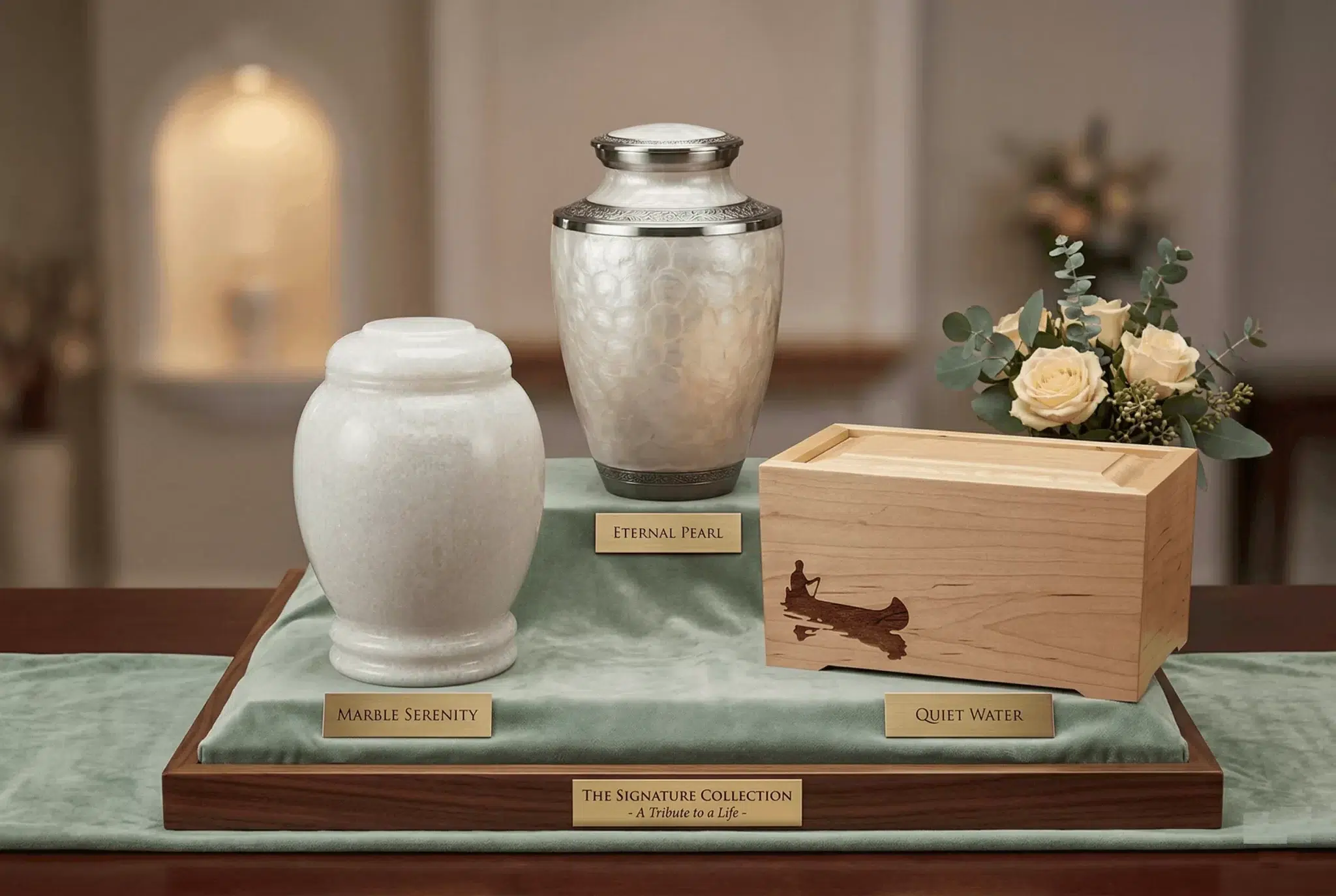
After the cremation has been completed, the cremated remains are placed in an urn or temporary container and returned to the family.
At this point, families have time to consider their next decisions.
Options may include:
- Keeping the urn at home
- Placing the urn in a cemetery
- Selecting a columbarium
- Planning a memorial service
- Holding a celebration of life
- Scattering cremated remains where permitted
There is generally no requirement for families to make all of these decisions immediately
What Is Included in a Direct Cremation?
What Is Usually Not Included in a Direct Cremation?
- Public visitation
- Viewing or visitation facilities
- Funeral chapel service before cremation
- Reception facilities
- Embalming services unless specifically requested or required
- Extensive floral arrangements
- Large ceremonial services
This does not mean these options are unavailable.
Many families who choose direct cremation later arrange a celebration of life, religious service, or gathering that reflects their own wishes.
Funeral Director’s Tip
A common misconception is that families must choose between “a funeral” or “nothing.” In reality, there are many ways to honour a person. Direct cremation can be followed by a meaningful ceremony, gathering, or tribute that is completely personalized to the family.Why Direct Cremation Costs Less Than a Traditional Funeral
The cost difference between direct cremation and a traditional funeral is primarily related to the number of services, facilities, and products selected.
A traditional funeral may involve:
- A visitation period
- Funeral home facilities
- Chapel or church service coordination
- Reception arrangements
- Additional staffing
- Embalming or preparation services
- Transportation services
- Caskets or other merchandise
Direct cremation focuses on the essential services required for cremation and allows families to decide which additional memorial options they want.
The goal is not that one choice is better than another.
The goal is that families understand the available options and select the arrangement that best reflects their values, wishes, and circumstances.
Direct Cremation Costs in Ontario
The cost of direct cremation varies depending on the provider, location, and services included.
Many traditional full-service funeral homes offering direct cremation packages may charge approximately $3,500–$5,000 or more, depending on what is included.
Affordable Cremations provides a transparent all-inclusive Direct Cremation Package for $1,938, designed for families seeking a simple and dignified cremation option with clear pricing.
When comparing prices, families should look beyond the advertised number and ask:
- What services are included?
- Are there additional fees?
- Is transportation included?
- Is the urn included?
- Are government fees included?
- Is the provider licensed?
- Who will guide the family through the process?
A clear comparison helps families make informed decisions.
Direct Cremation Is About Choice
There is no single “right” way to honour a life.
Some families find comfort in a traditional funeral with visitation and ceremony.
Others prefer a simple cremation followed by a private gathering.
Others choose a celebration of life weeks later when family and friends can come together.
Direct cremation provides another option—one that emphasizes simplicity, flexibility, and personal choice.
Direct Cremation vs. Traditional Funeral: Understanding the Difference
One of the most common questions families ask is:
"What is the difference between direct cremation and a traditional funeral?"
The answer depends largely on the timing of services and the type of experience a family wants to create.
A traditional funeral usually involves a gathering or ceremony before the final disposition takes place. Direct cremation focuses on completing the cremation first, with any memorial gathering planned afterward if the family wishes.
Neither option is more meaningful than the other.
The right choice depends on personal beliefs, cultural traditions, financial considerations, family circumstances, and the wishes of the person who died.
Comparison: Direct Cremation vs Traditional Funeral
|
|
Direct Cremation |
Traditional Funeral |
|---|---|---|
|
Main focus |
Simple cremation arrangement |
Funeral ceremony and gathering |
|
Timing |
Cremation occurs before a memorial (if planned) |
Service usually occurs before burial or cremation |
|
Visitation |
Not included |
Often included |
|
Viewing |
Generally not included |
May be included |
|
Funeral service |
Can be arranged later |
Usually part of the immediate arrangement |
|
Memorial flexibility |
High flexibility |
Usually planned within days |
|
Facilities used |
Fewer facilities required |
Funeral home facilities often used |
|
Cost |
Generally lower |
Generally higher due to additional services |
|
Family involvement |
Often planned later |
Often immediate |
|
Personalization |
Celebration can be planned at any time |
Personalization occurs during funeral planning |
Why Some Families Prefer Direct Cremation
Families choose direct cremation for many different reasons.
Simplicity
Some families prefer a straightforward process without organizing a large gathering immediately after a death.
This can be especially helpful when emotions are overwhelming and family members need time before making additional decisions.
Flexibility
A memorial service does not have to happen immediately.
Families may choose to gather:
- Weeks later
- Months later
- On a meaningful anniversary
- At a location that was special to their loved one
This flexibility can allow for a more thoughtful tribute.
Cost Considerations
Many families today carefully consider how funeral expenses fit within their financial circumstances.
Direct cremation allows families to focus on essential professional services while choosing additional memorial options based on their own priorities.
Family Circumstances
Modern families are often spread across different cities, provinces, or countries.
A direct cremation can allow additional time for:
- Travel arrangements
- Scheduling family members
- Planning a meaningful gathering
- Coordinating religious or cultural traditions
Why Some Families Prefer a Traditional Funeral
A traditional funeral remains an important choice for many families.
Some families value:
- Having relatives gather immediately
- A formal opportunity to say goodbye
- Religious or cultural traditions
- Viewing and visitation
- Support from their community
- A structured ceremony
For some people, the funeral itself provides an important part of the grieving process.
The important thing is that families understand their choices and select the option that feels appropriate for them.
Funeral Director's Tip
The most meaningful funeral arrangements are not necessarily the largest or most expensive. They are the ones that reflect the wishes, personality, beliefs, and relationships of the person being remembered.
Common Myths About Direct Cremation
Despite becoming increasingly common, direct cremation is still misunderstood by many people.
Let’s address some of the most common questions.
Myth #1: "Direct Cremation Means There Is No Way to Have a Memorial Service"
False.
Many families choose direct cremation specifically because it gives them more flexibility.
A celebration of life, memorial service, church ceremony, or private gathering can often take place after the cremation.
Some families find this creates a more relaxed and personal experience because they are not limited by the immediate timeline after death.
Myth #2: "Choosing Direct Cremation Means Less Care Is Provided"
False.
Professional standards apply regardless of the type of funeral arrangement selected.
Licensed Funeral Directors continue to provide:
- Professional guidance
- Documentation assistance
- Transportation coordination
- Identification procedures
- Care throughout the process
The difference is the type of services selected—not the level of respect provided.
Myth #3: "The Family Must Decide Everything Immediately"
Usually false.
One benefit of direct cremation is that many decisions can be made later.
Families often have time to consider:
- Memorial plans
- Urn selection
- Cemetery options
- Scattering options
- Celebration of life details
Myth #4: "Direct Cremation Is Only Chosen Because It Is Less Expensive"
False.
While affordability is an important factor for many families, it is not the only reason people choose direct cremation.
Other reasons include:
- Simplicity
- Personal preference
- Environmental considerations
- Family location
- Less formal traditions
- The wishes of the person who died
Myth #5: "Cremated Remains Must Be Buried Immediately"
False.
Families have various options after cremation.
Depending on personal wishes and applicable regulations, families may choose to:
- Keep the urn
- Arrange cemetery placement
- Use a columbarium
- Plan a memorial
- Scatter cremated remains where permitted
Frequently Asked Questions About Direct Cremation in Ontario
1. How much does direct cremation cost in Ontario?
Direct cremation costs vary depending on the provider and what services are included.
Many traditional funeral homes offering direct cremation services may charge approximately $3,500–$5,000 or more.
Affordable Cremations provides an all-inclusive direct cremation package priced at $1,938.
Families should always request a detailed explanation of included services before making a decision.
2. How long does direct cremation take?
The timeline depends on several factors, including:
- Location of death
- Completion of required documentation
- Medical certification
- Required authorizations
- Scheduling availability
A Funeral Director can provide guidance based on the specific circumstances.
3. Can direct cremation be arranged from a hospital?
Yes.
Funeral establishments regularly assist families when a death occurs in hospitals, retirement residences, long-term care facilities, hospices, and private residences.
4. Can I arrange direct cremation without visiting a funeral home?
Yes.
Many arrangements can be completed through telephone conversations and electronic documentation, depending on the circumstances.
5. Is an urn included with direct cremation?
This depends on the provider and package selected.
Affordable Cremations includes a standard urn as part of its all-inclusive direct cremation package.
6. Can I still have a religious service after direct cremation?
Yes.
Many families choose to hold religious ceremonies, celebrations of life, or memorial gatherings after cremation.
7. Who can authorize a cremation in Ontario?
Authorization requirements depend on the circumstances of the death and applicable Ontario legislation.
A Funeral Director can explain who has legal authority and assist families with the required documentation.
8. Can ashes be scattered in Ontario?
Scattering cremated remains may be possible depending on the location and applicable rules.
Families should check requirements for private property, municipal property, conservation areas, parks, or other locations before scattering.
9. Do I need to buy an expensive urn?
No.
Families have many options. Some choose a simple urn, while others select a personalized memorial container later.
10. Is direct cremation becoming more common?
Yes.
Cremation has become increasingly common throughout Ontario and Canada as families seek options that reflect modern lifestyles, changing traditions, and personal preferences.
Ontario Direct Cremation Laws and Professional Standards
Families often have questions about the rules surrounding cremation in Ontario.
Cremation is regulated under provincial legislation, and licensed funeral professionals must follow established requirements designed to protect families and ensure proper procedures are followed.
The Bereavement Authority of Ontario (BAO) is the regulator responsible for overseeing funeral, burial, and cremation services in Ontario.
The BAO provides information about:
- Funeral service providers
- Consumer rights
- Funeral service regulations
- Licensing requirements
- Complaints and concerns
Families can visit:
Bereavement Authority of Ontario
Is Cremation Regulated in Ontario?
Yes.
Ontario's funeral, burial, and cremation industry operates under provincial legislation, including the:
Funeral, Burial and Cremation Services Act, 2002
This legislation establishes requirements related to funeral services, cemeteries, crematoriums, and consumer protection.
The purpose of regulation is to ensure:
- Proper licensing
- Professional accountability
- Accurate documentation
- Consumer protection
- Respectful handling of human remains
Choosing a Licensed Funeral Provider
When comparing cremation providers, families should consider more than price alone.
Important questions to ask include:
Is the provider licensed in Ontario?
Licensed funeral establishments operate under provincial requirements and are accountable to regulatory standards.
What exactly is included in the price?
A lower advertised price may not always include the same services as another provider.
Families should ask about:
- Transportation
- Documentation assistance
- Cremation fees
- Urn or container
- Administrative fees
- Additional circumstances that may affect pricing
Who will guide my family through the process?
A knowledgeable Funeral Director should be available to explain options, answer questions, and help families understand each step.
Funeral Director's Tip
The best question to ask any funeral provider is not simply "What is your price?" but "What is included in your price?" A clear explanation of services helps families compare options fairly and avoid unexpected costs.
What Happens After the Cremated Remains Are Returned?
Receiving cremated remains can be an emotional moment for families.
Some families already know what they would like to do. Others need time.
There is no single correct way to honour someone.
Common options include:
Keeping Cremated Remains
Some families choose to keep an urn at home in a special location.
This allows family members to maintain a personal connection and create a private memorial space.
Cemetery Placement
Families may choose to place cremated remains in:
- A cemetery plot
- A cremation garden
- A niche or columbarium
Cemetery options vary by location.
Celebration of Life
A celebration of life can take place after cremation and may be held:
- At a funeral home
- At a place of worship
- At a community facility
- At home
- At a meaningful location
Scattering Cremated Remains
Some families choose scattering as a meaningful tribute.
Before scattering, families should confirm whether permission is required at the chosen location.
Rules may vary depending on whether the location is:
- Private property
- Municipal property
- Conservation land
- Provincial park
- Other public areas
Planning Ahead: Prearranging Direct Cremation
Many people choose to plan their own funeral arrangements in advance.
Preplanning can provide several benefits:
- Reduces decisions for family members
- Allows personal wishes to be documented
- Provides an opportunity to understand available options
- Can reduce uncertainty during an emotional time
A pre-arrangement conversation does not mean everything must be finalized immediately.
Many families begin simply by asking questions and understanding their choices.
Direct Cremation Across Ontario
Affordable Cremations proudly provides information and services for families throughout many communities across Ontario.
Our local resource pages provide location-specific information, including:
- Direct Cremation Mississauga
- Direct Cremation Toronto
- Direct Cremation Etobicoke
- Direct Cremation Brampton
- Direct Cremation Milton
- Direct Cremation Oakville
- Direct Cremation Burlington
- Direct Cremation Hamilton
- Direct Cremation Stoney Creek
- Direct Cremation Grimsby
- Direct Cremation Smithville
- Direct Cremation St. Catharines
- Direct Cremation Niagara Falls
- Direct Cremation Welland
- Direct Cremation Fort Erie
- Direct Cremation Lincoln / Beamsville
- Direct Cremation Brantford
- Direct Cremation Cambridge
- Direct Cremation Kitchener
- Direct Cremation Waterloo
- Direct Cremation Guelph
- Direct Cremation Niagara-on-the-Lake
Each community has unique facilities, hospitals, retirement residences, and family needs. Our local pages are designed to help families find relevant information close to home.
Trusted Ontario Resources
The following organizations provide reliable information related to death registration, funeral services, and government programs.
Bereavement Authority of Ontario
The provincial regulator for funeral, burial, and cremation services.
Government of Ontario
Information about provincial services, including death registration.
ServiceOntario
Information about ordering government documents, including death certificates.
https://www.ontario.ca/page/serviceontario
Service Canada – Canada Pension Plan Death Benefit
Information about eligibility and application requirements.
Frequently Asked Questions Summary
What is direct cremation?
Direct cremation is cremation without a visitation or funeral service beforehand.
Is direct cremation respectful?
Yes. Professional care, documentation, identification procedures, and legal requirements remain part of the process.
Is direct cremation cheaper than a traditional funeral?
Generally, yes, because fewer services and facilities are involved.
Can I hold a memorial after direct cremation?
Yes. Many families choose to hold a celebration of life later.
Can arrangements be made remotely?
Often yes. Many families complete arrangements through telephone and electronic communication.
About Affordable Cremations
Affordable Cremations is an Ontario funeral establishment providing families with a simple, dignified, and transparent option for direct cremation.
Our purpose is to help families understand their choices and provide professional guidance without unnecessary pressure.
We believe every family deserves:
- Clear information
- Honest pricing
- Respectful care
- Professional guidance
- The ability to choose an option that reflects their needs
Our all-inclusive Direct Cremation Package is $1,938, providing families with an affordable alternative while maintaining the professionalism and dignity expected from a licensed Ontario funeral provider.
Affordable Cremations serves families throughout the Greater Toronto Area, Halton Region, Hamilton Region, Niagara Region, Waterloo Region, Brant County, and surrounding communities.